The Five Breathing Techniques in Refresher — and How to Pick One
A side-by-side comparison of box breathing, 4-7-8, coherent breathing, the Wim Hof method, and silent timed meditation. With a short decision tree for picking the right one for the moment.

The breathing app market is full of products that bundle dozens of techniques without explaining when to use which one. This is the short, opinionated guide that explains when to use which one.
Try every technique on iPhone
Guided sessions for every technique above, plus HealthKit logging and custom presets. Free to start.
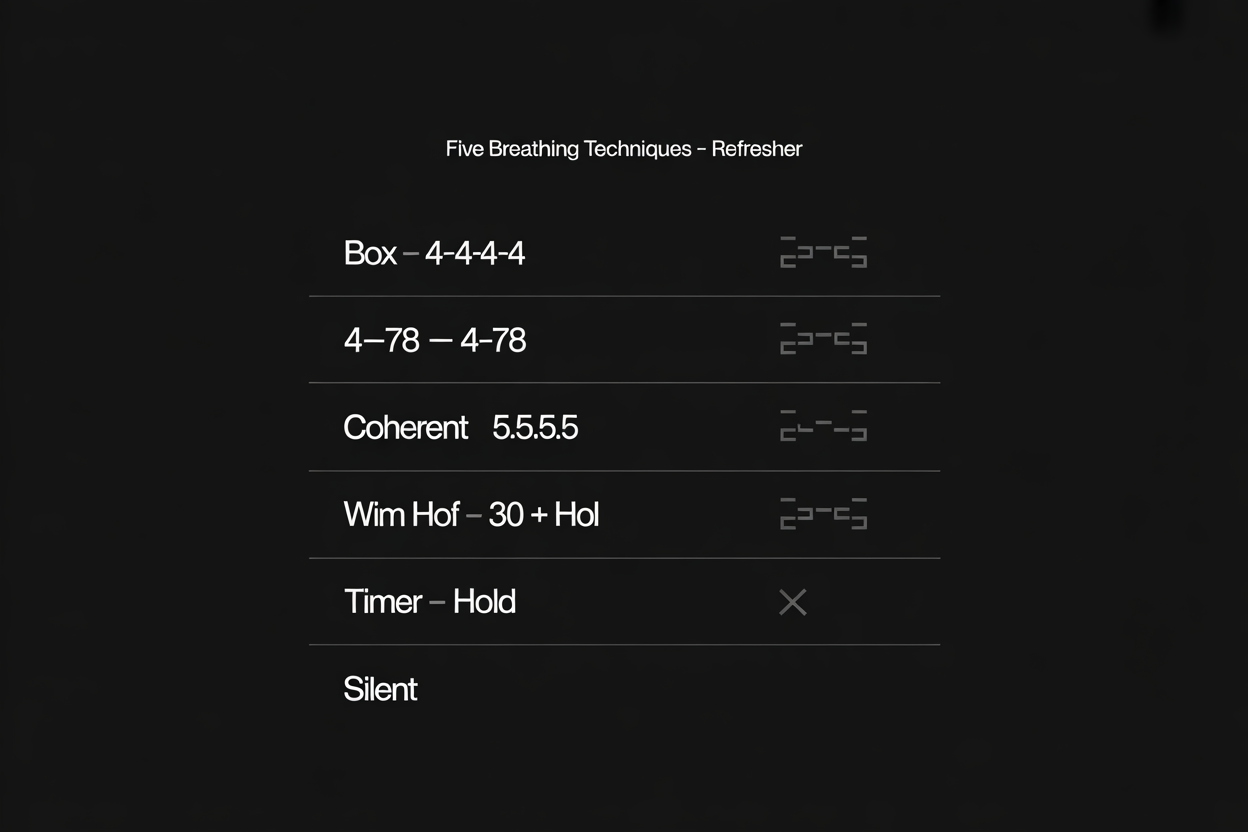
The five techniques at a glance
| Technique | Pattern | Best for | Difficulty |
|---|---|---|---|
| Box Breathing | 4 · 4 · 4 · 4 | Focus, pre-performance calm | Beginner |
| 4-7-8 Breathing | 4 · 7 · 8 | Falling asleep, calming anxiety | Beginner |
| Coherent Breathing | 5.5 in · 5.5 out | Daily HRV, cardiovascular health | Beginner |
| Wim Hof Method | 30 power breaths + hold | Energy, immune resilience | Advanced |
| Mindfulness Timer | Natural breath, timed | Mindfulness, flexibility | Beginner |
A short decision tree
The honest version of which technique should I use fits in a paragraph. Anxious right now? 4-7-8 breathing. Need focus right now? Box breathing. Want a daily cardiovascular practice? Coherent breathing. Want energy and resilience training? Wim Hof Method, in the morning, lying down. Just want to sit? Mindfulness timer.
You do not need all five. Most people benefit most from picking one as a daily anchor — coherent breathing or silent meditation are the usual choices — and reaching for the others situationally.
What separates them
The five techniques split along three axes: pattern symmetry, breath holds, and intent.
Symmetry. Box and coherent breathing both use equal phases. 4-7-8 deliberately stretches the exhale. The Wim Hof Method is built around an extended retention. Mindfulness timer abandons pattern entirely. Asymmetric techniques tend to push the body in a particular direction (4-7-8 toward parasympathetic, Wim Hof toward sympathetic-then-parasympathetic). Symmetric techniques are general-purpose nervous-system settlers.
Holds. 4-7-8 and box breathing include holds that briefly elevate CO₂. Coherent breathing has no holds at all — it is a continuous wave. The Wim Hof Method's central feature is the long retention. Mindfulness timer involves no breath manipulation. Holds are the lever for training the body to tolerate higher arousal; their absence is what makes coherent breathing pleasant to sustain for ten minutes.
Intent. Box breathing and 4-7-8 are acute-use tools. Coherent breathing and mindfulness timer are daily-practice tools. The Wim Hof Method is a training protocol, with both acute and long-term effects. Choosing wisely means matching tool to context — using a training protocol as an acute tool tends to be exhausting; using an acute tool as a training protocol tends to be boring.
Practical pairings
A daily anchor of coherent breathing — five to ten minutes in the morning — covers the long-term cardiovascular goals.
Box breathing handles the in-between moments: the four minutes before a difficult meeting, the start of a focus block, the recovery from an interruption.
4-7-8 breathing lives in two places: bedside, and in your pocket for genuinely panicky moments.
The Wim Hof Method, if it appeals to you, is a deliberate add-on — three rounds in the morning, two or three times a week, never near water, never standing.
Silent meditation is the cool-down after any of the above, and the standalone practice on the days you do not want any of the others.
Practice all five on iPhone
Refresher includes guided sessions for every technique on this page, with technique-specific visualizations (Crystal Cube for Box, Lunar Tide for 4-7-8, Heart Rhythm for Coherent, Volcanic Core for Wim Hof, Sand Timer for Mindfulness Timer), HealthKit logging, an Apple Watch companion mode, and — for premium users — a custom builder for designing your own protocols. The five base techniques are all free.

Box Breathing: The 4-4-4-4 Technique Used by Navy SEALs
A simple breathing pattern with four equal phases — inhale four, hold four, exhale four, hold four. Used by special forces before high-stakes moments to lower heart rate and sharpen focus.

Coherent Breathing at 5.5 Breaths per Minute: The HRV Sweet Spot
A continuous, equal-phase breath at the body's resonance frequency. The pattern that maximises heart rate variability and synchronises the cardiovascular and respiratory systems.
Practice on iPhone
Refresher includes guided sessions for every technique on this site, with HealthKit logging, an Apple Watch companion, and a custom preset builder.
Open in App Store