Box Breathing: The 4-4-4-4 Technique Used by Navy SEALs
A simple breathing pattern with four equal phases — inhale four, hold four, exhale four, hold four. Used by special forces before high-stakes moments to lower heart rate and sharpen focus.

There's a reason Navy SEALs, surgeons, and emergency dispatchers all reach for the same breathing pattern when the next sixty seconds matter. It is the most boring breathing technique you'll ever learn, and that is precisely the point.
Practice Box Breathing on iPhone
Guided Box Breathing sessions with the Crystal Cube visualization, customizable rounds, and HealthKit logging. Free to start.
What box breathing is
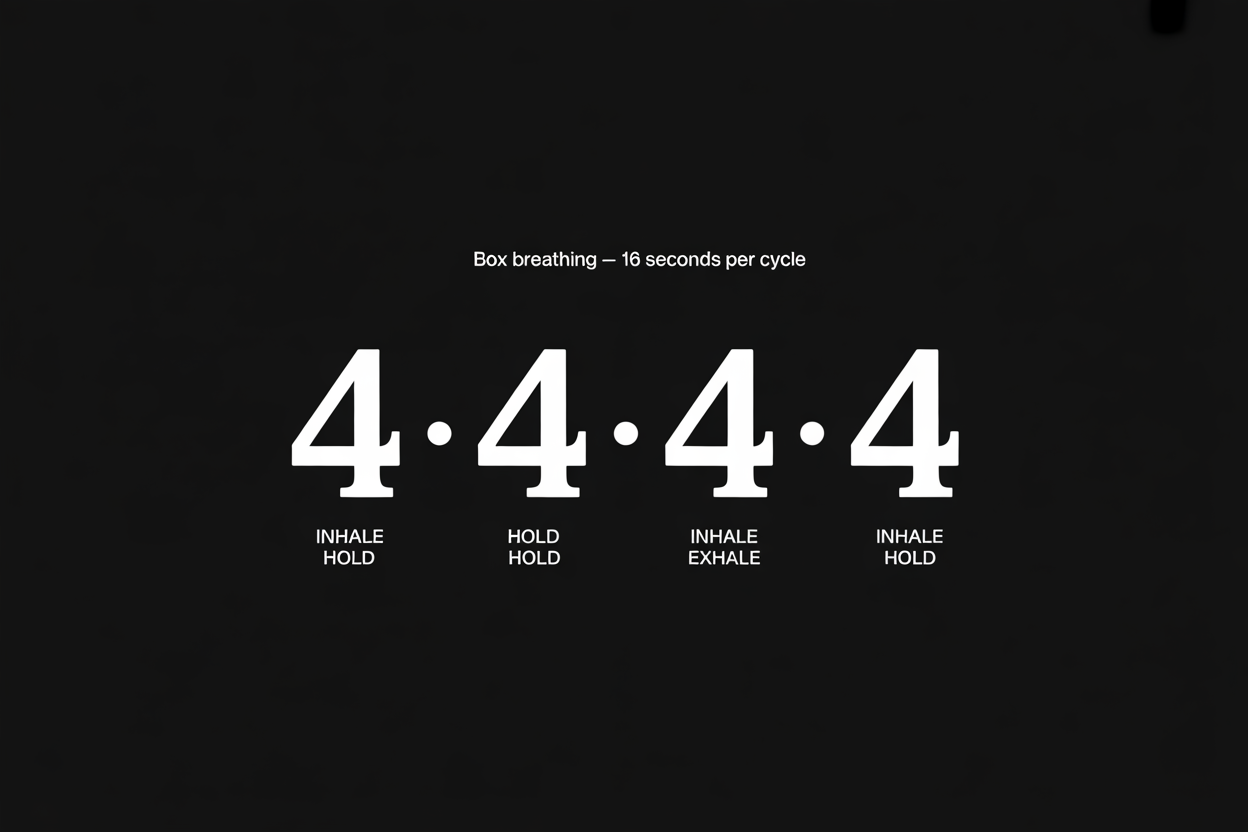
Box breathing — also called square breathing or tactical breathing — divides one breath cycle into four equal segments of four seconds each. You inhale for four. You hold the full breath for four. You exhale for four. You hold the empty lungs for four. Then you start again. One cycle takes sixteen seconds; four cycles take roughly a minute.
The pattern has no surprises, no asymmetric ratios, no counting drift. That regularity is the active ingredient. Your nervous system gets handed a metronome and a shape, and it stops trying to invent something more interesting.
Why it works
Slow, equal-phase breathing pulls the diaphragm into rhythm and engages the parasympathetic nervous system — the branch of the autonomic system responsible for the rest-and-digest state. Studies on controlled breathing show measurable drops in cortisol, lower resting heart rate, and improved emotional regulation after even short sessions. The breath holds add a second mechanism: a brief, voluntary increase in CO₂ that broadens the body's tolerance for arousal, which is why the technique is taught as a tool for high-pressure performance, not just for relaxation.
Former Navy SEAL commander Mark Divine popularised box breathing as part of his pre-mission protocol, and the practice has since spread through military, law enforcement, and emergency services. Its appeal in those contexts is functional: it requires no equipment, no posture, no privacy, and it works in the back of a vehicle or behind a desk.
How to do one cycle
- Sit comfortably, shoulders relaxed, jaw soft.
- Inhale through your nose for four seconds. Let your belly expand first, then your chest.
- Hold the full breath for four seconds. Stay relaxed — do not clench.
- Exhale through your mouth (or nose) for four seconds, slow and even.
- Hold the empty lungs for four seconds. Same instruction: stay relaxed.
- Repeat. A starter session is around eighteen rounds, or roughly five minutes.
When to use it
Box breathing is built for the in-between moments. Use it before a difficult conversation, before public speaking, between meetings when your attention has fragmented, or during the first ten minutes of a focus block when you want to settle in. It is less ideal as a sleep aid — for that, the longer-exhale 4-7-8 method is the better tool — and it is overkill for general daily wellbeing, where coherent breathing at 5.5 breaths per minute does more for long-term cardiovascular markers.
Common mistakes
The most frequent error in box breathing is also the most invisible: tensing during the holds. The hold phases are not feats of endurance, they are pauses. If you find yourself bracing your shoulders or stiffening your jaw at the top or bottom of the breath, you have turned the technique into resistance training. Loosen.
Other common pitfalls:
- Breathing from the chest. Box breathing assumes diaphragmatic breathing. Place a hand on your belly and check that it rises before your ribs do.
- Going too fast for your lungs. If four seconds feels strained, drop to three. The pattern matters more than the count.
- Counting unevenly. Use the seconds on a clock, an audible cue, or — easier — a guided session that handles the timing for you.
Practice it on iPhone
Refresher includes Box Breathing as one of its five free guided techniques, paired with a Crystal Cube visualization that illuminates a different face of a slowly rotating glass cube on each phase, so you can keep the pattern without watching a counter.
Where to go next
If you found box breathing too symmetrical to use as a sleep aid, the next post — 4-7-8 breathing — is its counterpart for winding down. If you want a daily practice that keeps the same simple, equal feel but optimises for cardiovascular health rather than acute focus, read the piece on coherent breathing.

4-7-8 Breathing for Sleep: Dr. Andrew Weil's Method, Explained
An asymmetric breathing pattern with a long, deliberate exhale. Built to engage the vagus nerve and tip the body into the parasympathetic state that precedes sleep.

Coherent Breathing at 5.5 Breaths per Minute: The HRV Sweet Spot
A continuous, equal-phase breath at the body's resonance frequency. The pattern that maximises heart rate variability and synchronises the cardiovascular and respiratory systems.
Practice on iPhone
Refresher includes guided sessions for every technique on this site, with HealthKit logging, an Apple Watch companion, and a custom preset builder.
Open in App Store