4-7-8 Breathing for Sleep: Dr. Andrew Weil's Method, Explained
An asymmetric breathing pattern with a long, deliberate exhale. Built to engage the vagus nerve and tip the body into the parasympathetic state that precedes sleep.

Of all the breathing patterns popularised in the last two decades, 4-7-8 is the one most often described as a sleep hack. That framing undersells it. The technique is not a trick — it is a deliberate use of one of the few autonomic levers humans can pull at will: the long exhale.
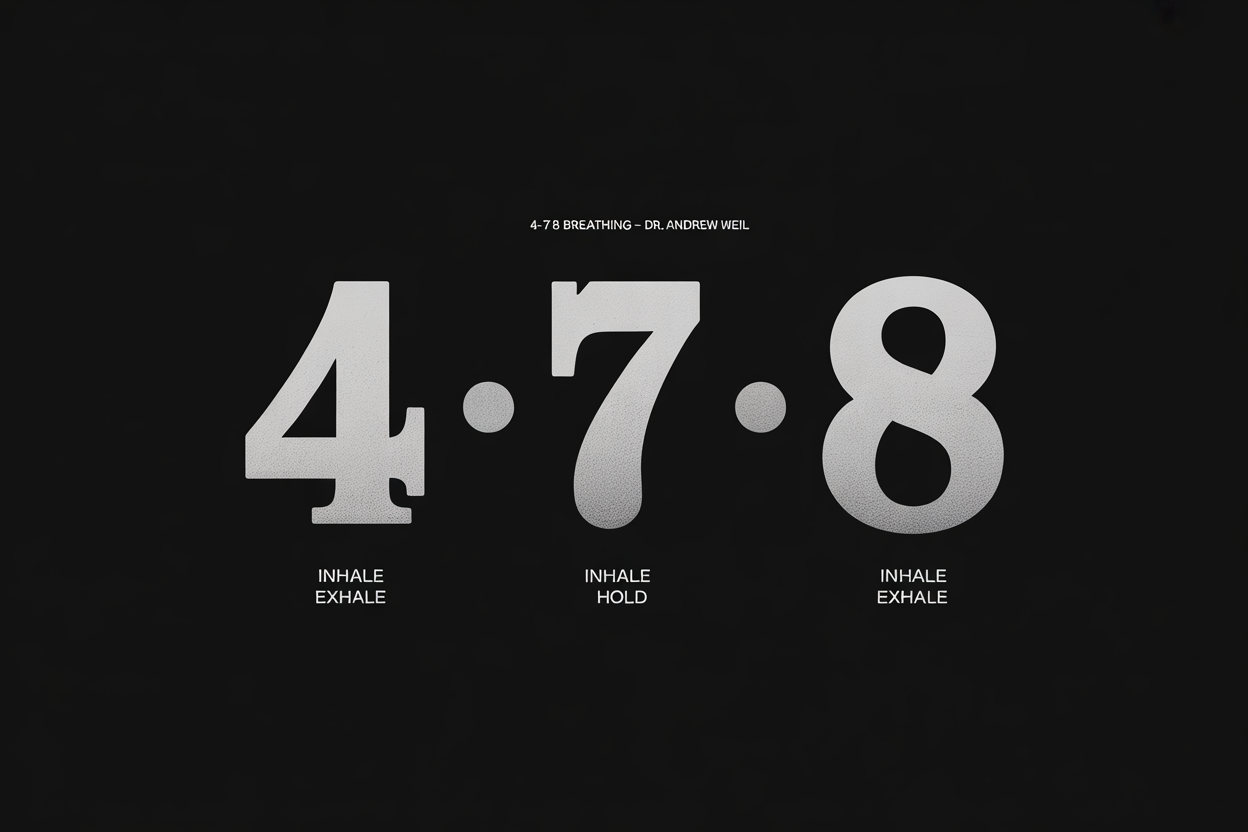
Practice 4-7-8 Breathing on iPhone
Guided 4-7-8 Breathing sessions with the Lunar Tide visualization, customizable rounds, and HealthKit logging. Free to start.
What 4-7-8 breathing is
4-7-8 is a single asymmetric breath cycle. You inhale through your nose for four seconds. You hold the full breath for seven seconds. You exhale through your mouth — slowly, often with a soft whoosh — for eight seconds. Then you start the next cycle.
One cycle takes about nineteen seconds, so a starter session of sixteen rounds runs around five minutes. The technique was developed by Dr. Andrew Weil, an American physician trained in integrative medicine who adapted it from the yogic tradition of pranayama. The numbers are not arbitrary: the eight-second exhale is the longest phase, and that is where almost all of the effect comes from.
Why the long exhale matters
The vagus nerve is the longest cranial nerve in the body. It carries roughly 80% of the parasympathetic signals that slow the heart, drop blood pressure, and quiet the gut. Long, slow exhalations activate it more strongly than any other voluntary act — slower than chewing, deeper than blinking, more sustained than talking. Heart rate drops measurably on every exhale (a phenomenon called respiratory sinus arrhythmia), and stretching the exhale exaggerates that drop.
Research on extended-exhalation breathing supports what practitioners report: faster onset of relaxation, reduced anxiety scores, and improved sleep latency. It is not a sedative — you do not feel drugged after a session — but the body settles into the same physiological gear it would naturally find in the minutes before falling asleep.
How to do one cycle
- Place the tip of your tongue against the ridge behind your upper front teeth. Keep it there throughout.
- Exhale completely through your mouth, emptying your lungs.
- Inhale quietly through your nose for four seconds.
- Hold the full breath for seven seconds.
- Exhale slowly through your mouth for eight seconds, making a soft whoosh sound around your tongue.
- Repeat. Four cycles is enough for an acute calm-down. Sixteen cycles is a full session.
When to use it
The two best moments are bedtime and acute anxiety. As a sleep aid, run a session in bed with the lights off, eyes closed. As a panic interrupt — before a presentation, after bad news, during travel — even four cycles will visibly slow your heart rate and unclench your shoulders. It is not the right tool for daytime focus (use box breathing instead) or for cardiovascular conditioning (use coherent breathing).
Two practical notes. Practising twice daily for a few weeks is more effective than reaching for it only in crisis — the technique works faster on a body that has done it before. And avoid practising right after eating, when the diaphragm is constrained.
Common mistakes
- Forcing the exhale. The whoosh is gentle, almost involuntary. If you sound like you are deflating a balloon, you are pushing too hard.
- Breaking tongue position. The tongue placement keeps the airway shape consistent across cycles. It feels awkward at first; it stops feeling awkward by the third session.
- Skipping the seven-second hold. The hold is what makes the long exhale possible — without it, you don't have enough air left to draw out the eight seconds smoothly.
Practice it on iPhone
Refresher includes 4-7-8 with a Lunar Tide visualization — a slowly rising and setting moon over still water, paced to the breath. The visualization is intentionally low-contrast and warm-toned for a reason: at bedtime, you do not want a screen that wakes you up.
Where to go next
For a daytime equivalent that keeps the asymmetry but trades sedation for sustained focus, read the box breathing post. If your interest in breathwork goes beyond sleep into long-term cardiovascular markers, the coherent breathing piece is the next stop.
Box Breathing: The 4-4-4-4 Technique Used by Navy SEALs
A simple breathing pattern with four equal phases — inhale four, hold four, exhale four, hold four. Used by special forces before high-stakes moments to lower heart rate and sharpen focus.
Coherent Breathing at 5.5 Breaths per Minute: The HRV Sweet Spot
A continuous, equal-phase breath at the body's resonance frequency. The pattern that maximises heart rate variability and synchronises the cardiovascular and respiratory systems.
Practice on iPhone
Refresher includes guided sessions for every technique on this site, with HealthKit logging, an Apple Watch companion, and a custom preset builder.
Open in App Store