Coherent Breathing at 5.5 Breaths per Minute: The HRV Sweet Spot
A continuous, equal-phase breath at the body's resonance frequency. The pattern that maximises heart rate variability and synchronises the cardiovascular and respiratory systems.

Coherent breathing is the breathing technique that has nothing to do with calming down. It is a cardiovascular practice. The goal is not to feel relaxed — though you will — it is to drive your heart and your lungs into mathematical phase with each other for several minutes at a time.
Practice Coherent Breathing on iPhone
Guided Coherent Breathing sessions with the Heart Rhythm visualization, customizable rounds, and HealthKit logging. Free to start.
What coherent breathing is
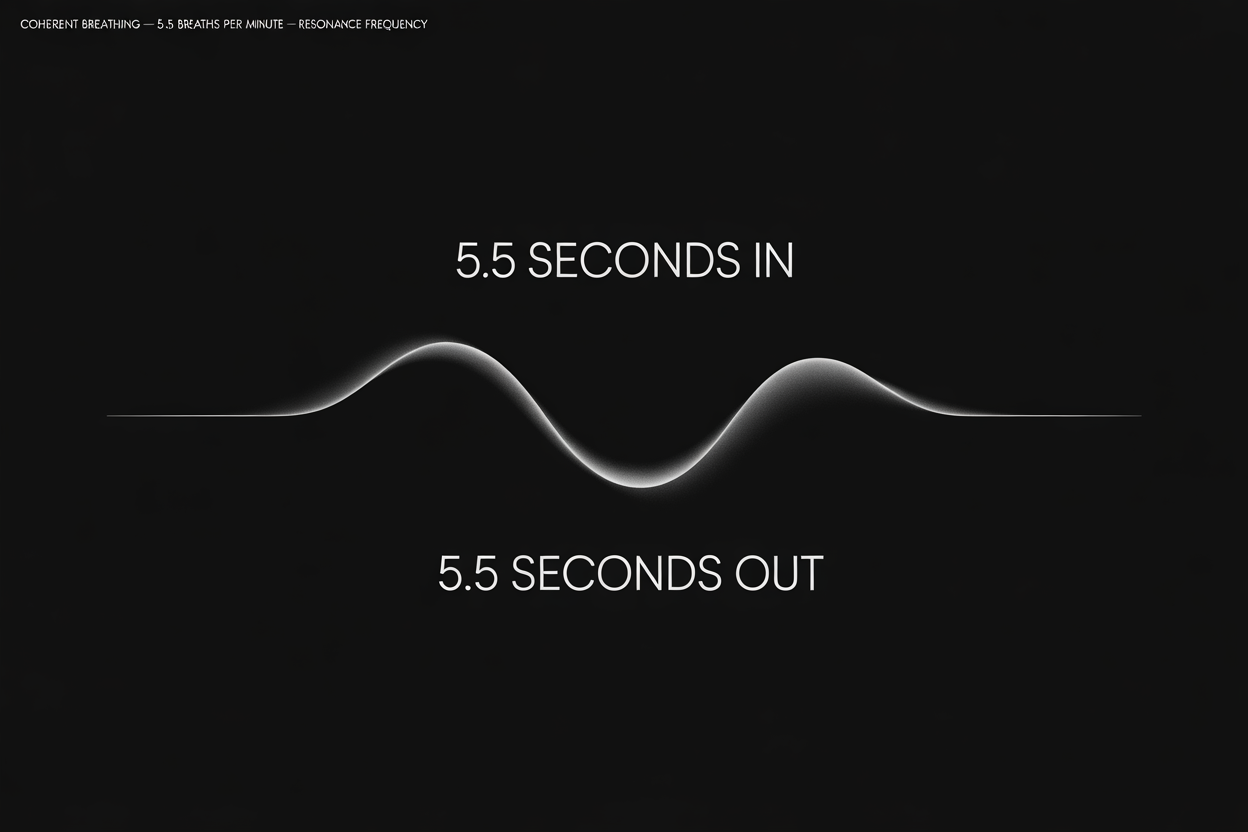
You inhale for five-and-a-half seconds. You exhale for five-and-a-half seconds. There are no holds. The breath is continuous and smooth, like a wave with no flat spots at the crest or the trough. One cycle takes eleven seconds; sixty seconds contains roughly five-and-a-half breaths.
That number — 5.5 breaths per minute — is not arbitrary. It is the resonance frequency of the average adult human cardiovascular system, the frequency at which the natural oscillations of heart rate, blood pressure, and respiration phase-lock into a single coherent waveform. Push faster and the systems desynchronise. Push slower and the same thing happens. Hit the sweet spot and an effect called heart rate variability — HRV — climbs to its biological maximum for the duration of the session.
Why HRV matters
HRV is the variation in time between consecutive heartbeats. A healthy heart is not metronomic; the gap between beats subtly stretches and compresses with the breath. High HRV correlates with cardiovascular health, longer lifespan, faster recovery from stress, and better emotional regulation. Low HRV correlates with the opposite — burnout, depression, cardiovascular disease.
Coherent breathing was formalised by Stephen Elliott, building on decades of HRV biofeedback research from Dr. Paul Lehrer and Dr. Richard Gevirtz. The Lehrer protocol, used in clinical settings for anxiety and depression, is essentially coherent breathing under instrumented supervision. The HeartMath Institute popularised the cardiac coherence model in the 1990s. The convergence is striking: physiologists, biofeedback clinicians, and contemplative traditions independently arrived at the same approximate cadence.
How to do one cycle
- Sit upright, spine long, shoulders heavy.
- Inhale through your nose for 5.5 seconds, letting your belly expand first.
- Without pausing, exhale through your nose for 5.5 seconds, smooth and continuous.
- Repeat. A starter session is twenty-seven cycles — about five minutes.
- There are no holds. Treat the breath as a sine wave, not a square wave.
If 5.5 seconds per phase feels too slow at first, start at 4 seconds and add half a second per session until 5.5 feels effortless. The number is the destination, not the entry point.
When to use it
Coherent breathing is the daily practice of breathwork. Five to ten minutes once a day, ideally in the morning, is enough to shift baseline HRV measurably over weeks. It is also useful as a pre-sleep wind-down (it doubles as a relaxation tool, even though that is not its primary aim) and as a between-meeting reset, though box breathing is sharper for the latter.
The technique is uniquely good for people who have tried calming breathwork and found it boring — coherent breathing is the version with a measurable physiological target, and the visible feedback of HRV apps (or just a finger on your radial pulse) gives the practice a quantitative edge that the relaxation-focused techniques don't.
Common mistakes
- Adding pauses. The most common error is to hold briefly at the top or the bottom of each breath. The whole protocol depends on continuity. Pauses break the resonance.
- Going too fast. 5.5 breaths per minute feels slow if you are used to 12–18. Trust the slowness; that is the dose.
- Chest breathing. Coherent breathing assumes diaphragmatic breathing. If your shoulders rise on the inhale, you are not yet there.
Practice it on iPhone
Refresher includes Coherent Breathing with a Heart Rhythm visualization — an ECG-style waveform that pulses with each breath cycle, designed to make the resonance frequency visible. The technique's pace is fully customisable, so you can ramp from 4-second phases up to the full 5.5 over your first weeks.
Where to go next
For an acute focus tool that uses equal phases but adds breath holds, read the box breathing post. For a sleep-onset technique that swaps continuity for an extended exhale, read the 4-7-8 breathing post.

Box Breathing: The 4-4-4-4 Technique Used by Navy SEALs
A simple breathing pattern with four equal phases — inhale four, hold four, exhale four, hold four. Used by special forces before high-stakes moments to lower heart rate and sharpen focus.

4-7-8 Breathing for Sleep: Dr. Andrew Weil's Method, Explained
An asymmetric breathing pattern with a long, deliberate exhale. Built to engage the vagus nerve and tip the body into the parasympathetic state that precedes sleep.
Practice on iPhone
Refresher includes guided sessions for every technique on this site, with HealthKit logging, an Apple Watch companion, and a custom preset builder.
Open in App Store