The Wim Hof Method: A Beginner's Guide to the Power-Breath-and-Hold Cycle
An advanced breathing protocol with three rounds of rapid hyperventilation followed by progressive breath retention. The method that produced the first peer-reviewed evidence of voluntary immune system modulation.

The Wim Hof Method is the only breathing technique on this list with peer-reviewed evidence of voluntary immune system modulation. It is also the only one that comes with safety warnings printed in capital letters. Both facts are connected.
Practice Power Breath by Wim Hof on iPhone
Guided Power Breath by Wim Hof sessions with the Volcanic Core visualization, customizable rounds, and HealthKit logging. Free to start.
What the Wim Hof Method is
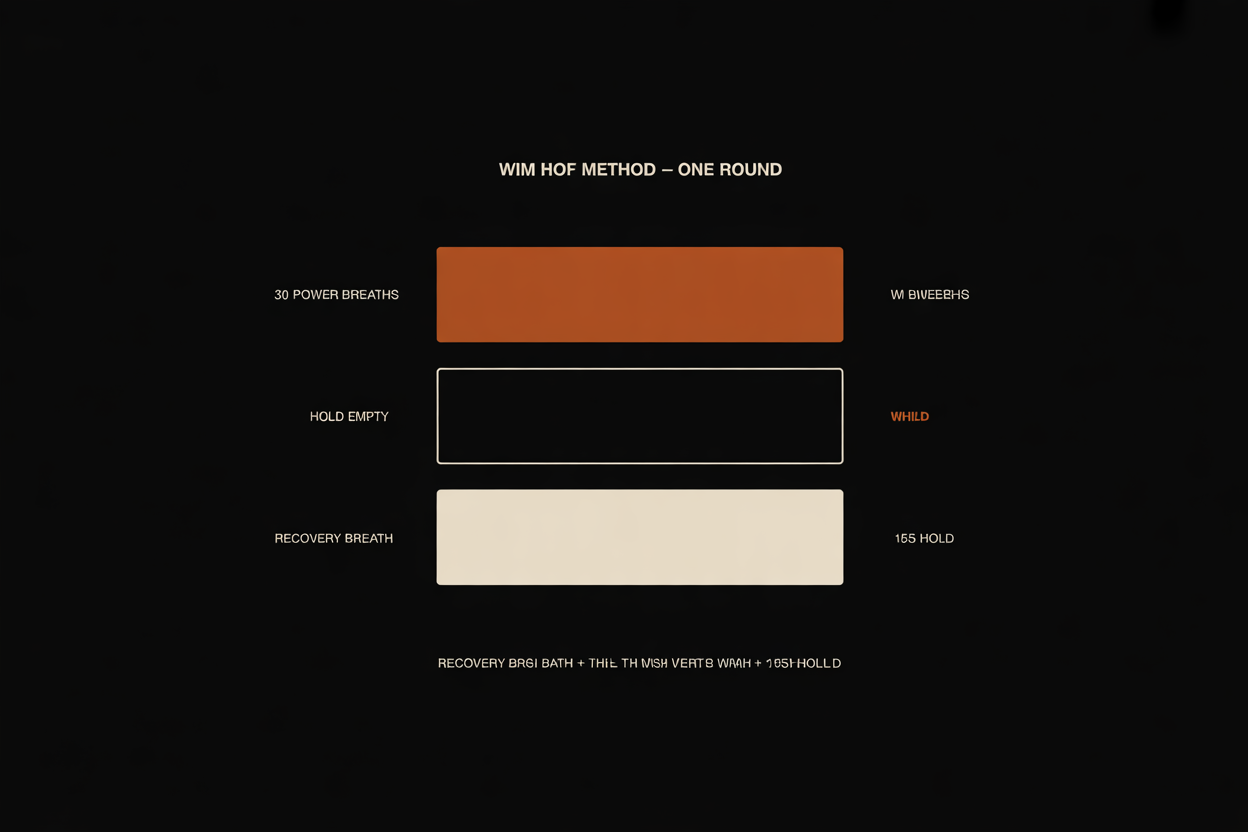
A single round consists of three phases. Power breathing: thirty fast, full inhales followed by gentle, passive exhales — roughly two-and-a-half seconds per breath. Breath retention: after the thirtieth exhale, you hold your lungs empty for as long as is comfortable, with no forcing. Recovery breath: a deep, full inhale held for fifteen seconds, then a complete exhale.
A typical beginner session is three rounds. With each round, the comfortable retention time tends to lengthen — the standard progression is roughly sixty, ninety, and one hundred and twenty seconds — and the total session runs about eleven minutes.
The method was popularised by Wim Hof, a Dutch extreme athlete who holds more than twenty Guinness World Records for cold exposure feats. He developed the protocol from his own practice and from the Tibetan tradition of Tummo, a meditative breath-and-heat practice. The method gained scientific credibility when the 2014 Kox et al. study in PNAS demonstrated that trained practitioners could voluntarily influence their immune response to an injected endotoxin — an effect that mainstream physiology had previously considered impossible.
Why it works
The two phases produce opposite, sequential effects. The power-breathing phase induces mild voluntary hyperventilation: blood pH rises, CO₂ drops, epinephrine surges, and the sympathetic nervous system briefly takes over. The body experiences a fight-or-flight chemical cascade triggered not by stress but by breath. The retention phase reverses this within seconds — heart rate drops, blood gases re-equilibrate, and the parasympathetic nervous system rebounds harder than baseline.
The training effect, over weeks of practice, is widened tolerance for both states. Practitioners report sharper energy on demand, faster recovery from stress, and — the part the Kox study formalised — measurable changes in inflammatory response. The cold exposure component (Hof teaches the breathing alongside cold showers and ice baths) compounds these effects but is not strictly required to begin.
How to do one round
Critical safety note before you start: practise lying down or seated, never standing, never in or near water, never while driving. Tingling and lightheadedness are normal during the power-breathing phase. Fainting is rare but possible — the position rule is what makes a faint harmless.
- Lie on your back or sit comfortably with your back supported.
- Take 30 deep breaths: full inhales through the nose or mouth, gentle passive exhales. Do not force the exhale — let it happen.
- After the thirtieth exhale, hold your lungs empty. Stay relaxed. No struggle. Hold until you feel a clear urge to breathe.
- Take a deep recovery inhale, fill your lungs completely, and hold for fifteen seconds.
- Exhale fully. That is one round.
- Most beginners run three rounds. Each subsequent retention tends to extend naturally — do not push.
When to use it
The Wim Hof Method is a morning protocol, not an evening one. Done before bed, the activation phase makes sleep harder. Most practitioners run it once a day, either right after waking or before exercise. It pairs well with cold exposure if that is part of your practice; it works on its own if not.
It is the wrong tool for acute calm — for that, use 4-7-8 breathing. It is also the wrong tool for sustained focus — that is what box breathing is for. The Wim Hof Method is for energising and resilience training, not for mid-task regulation.
Common mistakes
- Practising while standing or near water. This is the only breathing technique on this site that warrants a hard rule about position. Honour it.
- Forcing the breath hold. The retention is comfortable, not heroic. The benefit comes from being in the state, not from setting personal records.
- Skipping the recovery breath. That fifteen-second hold at full lungs is not optional. It restores blood gases and locks in the round.
- Starting with too many rounds. Three is plenty for the first month. The progression is in the duration of the holds, not in the number of rounds.
Practice it on iPhone
Refresher includes the Wim Hof Method with a Volcanic Core visualization — an energy orb that accumulates radial particle bursts during the power-breathing phase and stills to a pulse during retention. Heart rate is tracked through HealthKit if you grant permission, and the per-phase timeline is annotated with phase colours so you can see the sympathetic / parasympathetic flip happen on the chart after the session.
Where to go next
If the Wim Hof Method's intensity is more than you want from a daily practice, coherent breathing is the long-term cardiovascular tool — same goal of resilience, none of the activation. If you came here looking for a way to handle acute stress without the activation phase, box breathing is the one to read next.
Coherent Breathing at 5.5 Breaths per Minute: The HRV Sweet Spot
A continuous, equal-phase breath at the body's resonance frequency. The pattern that maximises heart rate variability and synchronises the cardiovascular and respiratory systems.

Box Breathing: The 4-4-4-4 Technique Used by Navy SEALs
A simple breathing pattern with four equal phases — inhale four, hold four, exhale four, hold four. Used by special forces before high-stakes moments to lower heart rate and sharpen focus.
Practice on iPhone
Refresher includes guided sessions for every technique on this site, with HealthKit logging, an Apple Watch companion, and a custom preset builder.
Open in App Store