Silent Timed Meditation: Why a Bell, a Timer, and a Cushion Still Win
No prescribed pattern, no guidance. A bell at the start, a bell at the end, and the breath you already have. The oldest practice on this list, and often the most useful one.

Every other technique on this site asks you to do something with your breath. This one asks you to let it alone.
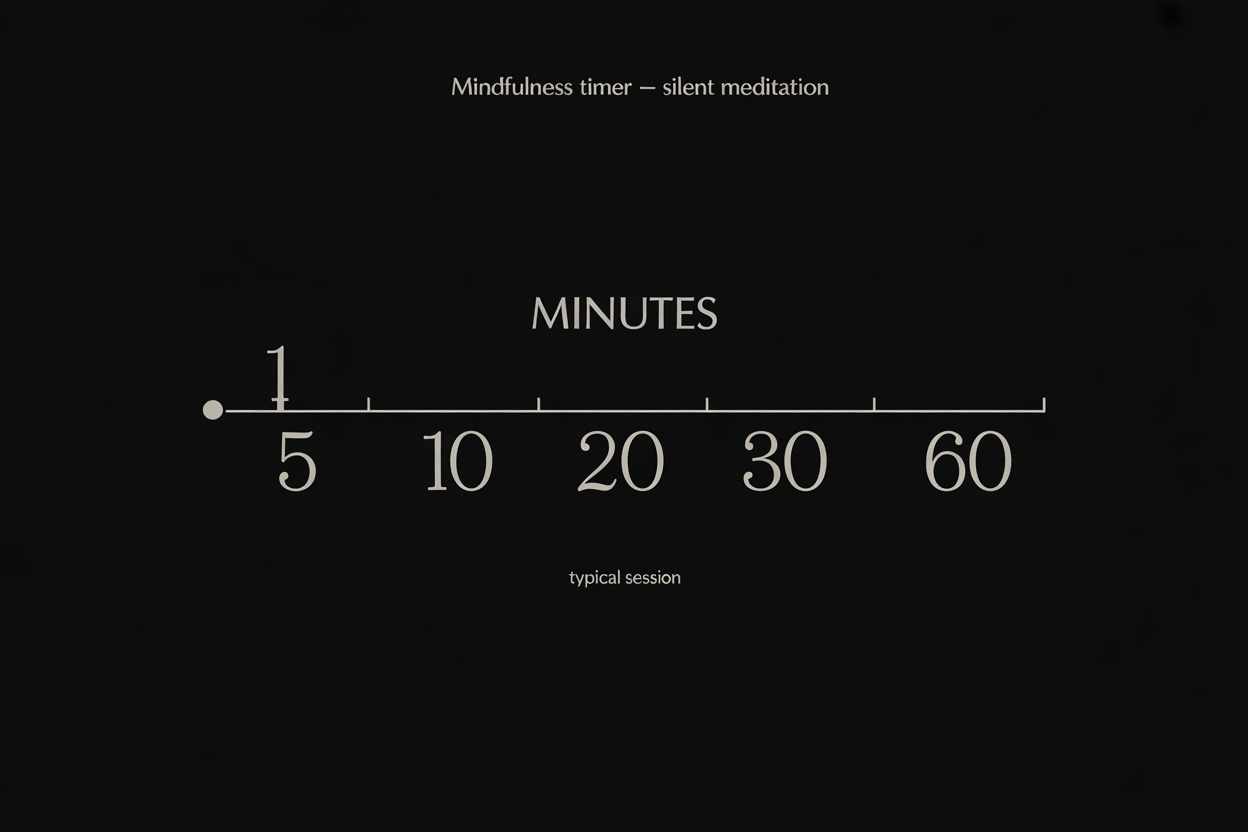
Set a silent meditation timer on iPhone
Guided Mindfulness Timer sessions with the Sand Timer visualization, customizable rounds, and HealthKit logging. Free to start.
What a timed silent meditation is
You choose a duration — anywhere from one to sixty minutes. A bell sounds. You sit. Your breath continues, naturally, with no instruction about pace, pattern, depth, or count. When your attention wanders, you notice that it has wandered, and you bring it back to the breath. Another bell sounds. The session is over.
That is the entire technique. There is no asymmetric ratio to remember, no resonance frequency to hit, no rounds to count. The format predates every other technique on this list by roughly two-and-a-half millennia.
Why it works
Modern mindfulness research is unusually well-supported by clinical evidence — far more than most contemplative practices, because the format is easy to standardise for trials. Programs like Mindfulness-Based Stress Reduction (MBSR), developed by Jon Kabat-Zinn at the University of Massachusetts in 1979, formalised silent timed meditation as a clinical intervention. Eight-week MBSR studies show reductions in cortisol, decreased anxiety scores, improved focus, and — strikingly — measurable changes in grey matter density in regions associated with attention and emotional regulation.
The technique pulls from the Zen and Vipassana traditions, both of which use bells to mark the beginning and end of seated practice. The bell is not decoration — it is the only structure the technique has, and that minimal structure is what makes the format scale from one-minute desk pauses to multi-day silent retreats without changing shape.
How to do one session
- Choose a duration. One to five minutes if it is your first time. Ten to twenty minutes for a daily practice. Longer if you have built up.
- Sit comfortably — chair, cushion, floor, bed. Spine reasonably upright, hands resting where they don't hurt.
- Close your eyes, or soften your gaze on a point a metre or two ahead.
- Let your breath continue naturally. Don't manage it.
- When you notice your mind has wandered — and it will — return your attention to the sensation of the breath. Not the idea of the breath, the sensation of it.
- The end bell signals the close. Open your eyes when you are ready.
When to use it
Silent timed meditation is the most flexible practice on this site. Five minutes between meetings. Twenty minutes after waking. Ten minutes before sleep, sometimes. It pairs well with the other techniques as a cool-down — finishing a coherent breathing session with two minutes of silent sitting often deepens the effect.
It is the wrong tool for acute crisis (use 4-7-8 breathing) and a poor choice when you are fully exhausted (you will fall asleep, which is fine, but you will not have meditated). It is the right tool for everything in between.
Common mistakes
- Trying to suppress thoughts. The instruction is to notice that the mind has wandered and return to the breath. Wandering is not failure; noticing is success.
- Treating it as another scheduled task. Silent meditation done while glancing at a counter every thirty seconds is just sitting still while anxious. Pick a duration, commit to it, let the bell handle the time.
- Going too long too fast. Twenty minutes a day, sustained, beats forty minutes once a week. Build the habit before you build the duration.
Practice it on iPhone
Refresher includes Mindfulness Timer with a choice of nine bell sounds — singing bowl, deep gong, handpan, drum, wind gust, magic chime, simple bell, strong gong, or none — for the start and end of each session. The visualization during the session is a simple amber sand timer with a minute-and-second readout, designed to be glance-friendly without becoming a focal point.
Where to go next
If silent meditation feels too unstructured to start, the coherent breathing post describes a daily practice with a clear physiological target that requires almost as little instruction. If you want a single page that compares all five techniques side-by-side, the overview post is the place.

Coherent Breathing at 5.5 Breaths per Minute: The HRV Sweet Spot
A continuous, equal-phase breath at the body's resonance frequency. The pattern that maximises heart rate variability and synchronises the cardiovascular and respiratory systems.
The Five Breathing Techniques in Refresher — and How to Pick One
A side-by-side comparison of box breathing, 4-7-8, coherent breathing, the Wim Hof method, and silent timed meditation. With a short decision tree for picking the right one for the moment.
Practice on iPhone
Refresher includes guided sessions for every technique on this site, with HealthKit logging, an Apple Watch companion, and a custom preset builder.
Open in App Store