4 by 4 Breathing Technique: A Simple Guide to the 4-4-4-4 Pattern
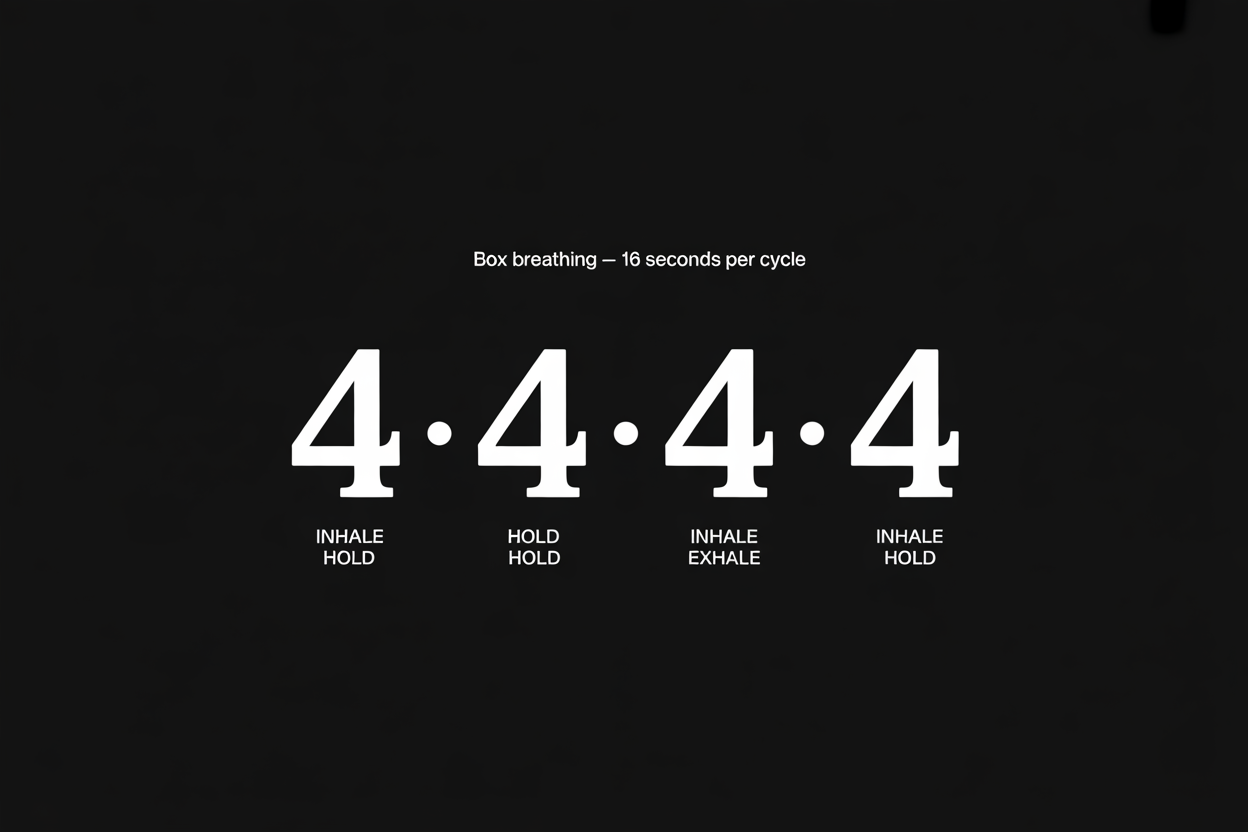
The 4 by 4 breathing technique is the simplest way to start box breathing: inhale for four, hold for four, exhale for four, and hold again for four.

The 4 by 4 breathing technique is the plain-English name for box breathing. You breathe in for four seconds, hold for four seconds, breathe out for four seconds, and hold again for four seconds. Four sides, four counts, four phases.
That is why the same practice is also called 4x4 breathing, 4-4-4-4 breathing, square breathing, or box breathing. The labels change, but the pattern stays the same.
Practice Box Breathing on iPhone
Guided Box Breathing sessions with the Crystal Cube visualization, customizable rounds, and HealthKit logging. Free to start.
What the 4 by 4 breathing technique is
A single 4 by 4 breathing cycle has four equal parts:
- Inhale for 4 seconds.
- Hold the full breath for 4 seconds.
- Exhale for 4 seconds.
- Hold after the exhale for 4 seconds.
Then you repeat the cycle. One round takes 16 seconds. Four rounds take just over a minute. A short practice can be three to five minutes.
The technique is popular because it is easy to remember under pressure. You do not need a script, a teacher, or a complicated ratio. You only need the number four.
Is 4 by 4 breathing the same as box breathing?
Yes. In most contexts, 4 by 4 breathing and box breathing mean the same thing.
The Cleveland Clinic describes box breathing as a four-count pattern: four counts breathing in, four counts holding, four counts exhaling, and four counts holding after the exhale. It also notes that the same technique is called 4x4 breathing, 4-4-4-4 breathing, four-square breathing, and square breathing.
So if you searched for "4 by 4 breathing technique" and landed here, you are in the right place. The more technical article on this site is our full box breathing guide. This page is the simpler starter version.
Why the pattern can help
When stress rises, breathing often becomes fast, shallow, and irregular. The point of 4 by 4 breathing is to give the nervous system a steady rhythm to follow.
The practice combines three useful elements:
- Slow breathing. Four-second phases reduce the pace compared with normal stressed breathing.
- Focused attention. Counting gives the mind one small job instead of letting it chase every thought.
- Gentle breath holds. The pauses create a clear shape and keep the cycle from becoming rushed.
The U.S. National Center for Complementary and Integrative Health describes deep breathing as one of the relaxation techniques used to produce the body's relaxation response, which is associated with slower breathing, lower blood pressure, and reduced heart rate. It also notes that slow diaphragmatic breathing may help reduce stress measures such as cortisol and blood pressure.
That does not make 4 by 4 breathing a medical treatment. It is a simple regulation exercise. Use it for ordinary stress, focus, and reset moments. If you have a respiratory, cardiac, panic, or blood pressure condition, use breathing techniques conservatively and talk with a clinician if you are unsure.
How to do 4 by 4 breathing
Start seated, standing still, or lying down. Keep the first session easy.
- Relax your shoulders and jaw.
- Exhale normally once, so you are not starting with a forced full inhale.
- Inhale through your nose for 4 seconds.
- Hold gently for 4 seconds.
- Exhale through your nose or mouth for 4 seconds.
- Hold gently for 4 seconds.
- Repeat for 4 to 12 rounds.
The word gently matters. The holds are pauses, not strain tests. If you feel air hunger, dizziness, pressure, or panic, shorten the count to three seconds or stop.
A one-minute starter session
If you want to try it now, do four rounds:
| Round | Inhale | Hold | Exhale | Hold |
|---|---|---|---|---|
| 1 | 4s | 4s | 4s | 4s |
| 2 | 4s | 4s | 4s | 4s |
| 3 | 4s | 4s | 4s | 4s |
| 4 | 4s | 4s | 4s | 4s |
That is only 64 seconds. It is long enough to interrupt a stress spike, but short enough that you can do it before a call, before opening your inbox, or while sitting in a parked car.
When to use 4 by 4 breathing
4 by 4 breathing is best for clear, contained moments:
- before a difficult conversation;
- after an interruption;
- before public speaking;
- between meetings;
- when you want to start a focus block calmly;
- when you are overwhelmed but still need to function.
It is less targeted for falling asleep than 4-7-8 breathing, because 4-7-8 makes the exhale much longer. It is also less useful as a daily cardiovascular practice than coherent breathing, which uses a continuous rhythm around 5.5 breaths per minute.
The strength of 4 by 4 breathing is simplicity. It is the technique you can remember when your brain is busy.
Common mistakes
Forcing the breath. Bigger is not better. Use a comfortable inhale and a smooth exhale.
Tensing during the holds. If your shoulders rise, your jaw tightens, or your face braces, soften the hold. You are pausing, not fighting.
Trying four seconds too early. If four seconds feels stressful, use three seconds for a week. The box shape matters more than the exact count.
Practicing only during crisis. It works better when the body has learned the rhythm during calm moments first.
How many rounds should you do?
For beginners, start with four rounds. That is about one minute.
For a fuller session, use 12 to 18 rounds. That is roughly three to five minutes.
More is not automatically better. If the practice stays comfortable, you can extend it. If it starts to feel forced, stop earlier. The goal is regulation, not endurance.
Practice it with Refresher
Refresher includes a guided Box Breathing mode for iPhone. The app handles the timing for you, so you do not have to count seconds while you are already stressed.
The visual pacer uses a calm four-phase rhythm, making the 4 by 4 pattern easier to follow without staring at a stopwatch. You can start with the free guided mode, log sessions to Apple Health, and use the same app for related techniques like 4-7-8, coherent breathing, Wim Hof-style power breathing, and silent meditation.
If you want a dedicated landing page for the app mode, see Box Breathing App for iPhone. If you want a broader comparison, read Breathing Techniques Compared.
Quick FAQ
Is 4 by 4 breathing good for anxiety?
It can help with everyday stress and anxious arousal because it slows the breath and focuses attention. It is not a substitute for medical or mental health care if anxiety is severe, persistent, or disruptive.
Should I breathe through my nose or mouth?
Nasal breathing is a good default. If exhaling through the mouth feels easier, use the mouth for the exhale. Comfort and smoothness matter more than strict rules.
Can I do 4 by 4 breathing before bed?
Yes, but it is not the most sleep-specific pattern. If your goal is sleep, try 4-7-8 breathing because the long exhale is designed for winding down.
What if four seconds feels too long?
Use 3 by 3 breathing: inhale three, hold three, exhale three, hold three. When that feels easy, move back to four.
Is it safe?
For most healthy adults, gentle 4 by 4 breathing is low-risk. Stop if you feel dizzy, short of breath, or uncomfortable. Do not force holds, and do not use breathwork to delay medical care.
Sources
Box Breathing: The 4-4-4-4 Technique Used by Navy SEALs
A simple breathing pattern with four equal phases — inhale four, hold four, exhale four, hold four. Used by special forces before high-stakes moments to lower heart rate and sharpen focus.
The Five Breathing Techniques in Refresher — and How to Pick One
A side-by-side comparison of box breathing, 4-7-8, coherent breathing, the Wim Hof method, and silent timed meditation. With a short decision tree for picking the right one for the moment.
Practice on iPhone
Refresher includes guided sessions for every technique on this site, with HealthKit logging, an Apple Watch companion, and a custom preset builder.
Open in App Store