5 Breaths Per Minute: The HRV Breathing Pace, Explained
A plain-English guide to breathing at five breaths per minute: what the pace means, why it is associated with HRV, and how it compares with 4-7-8 breathing.

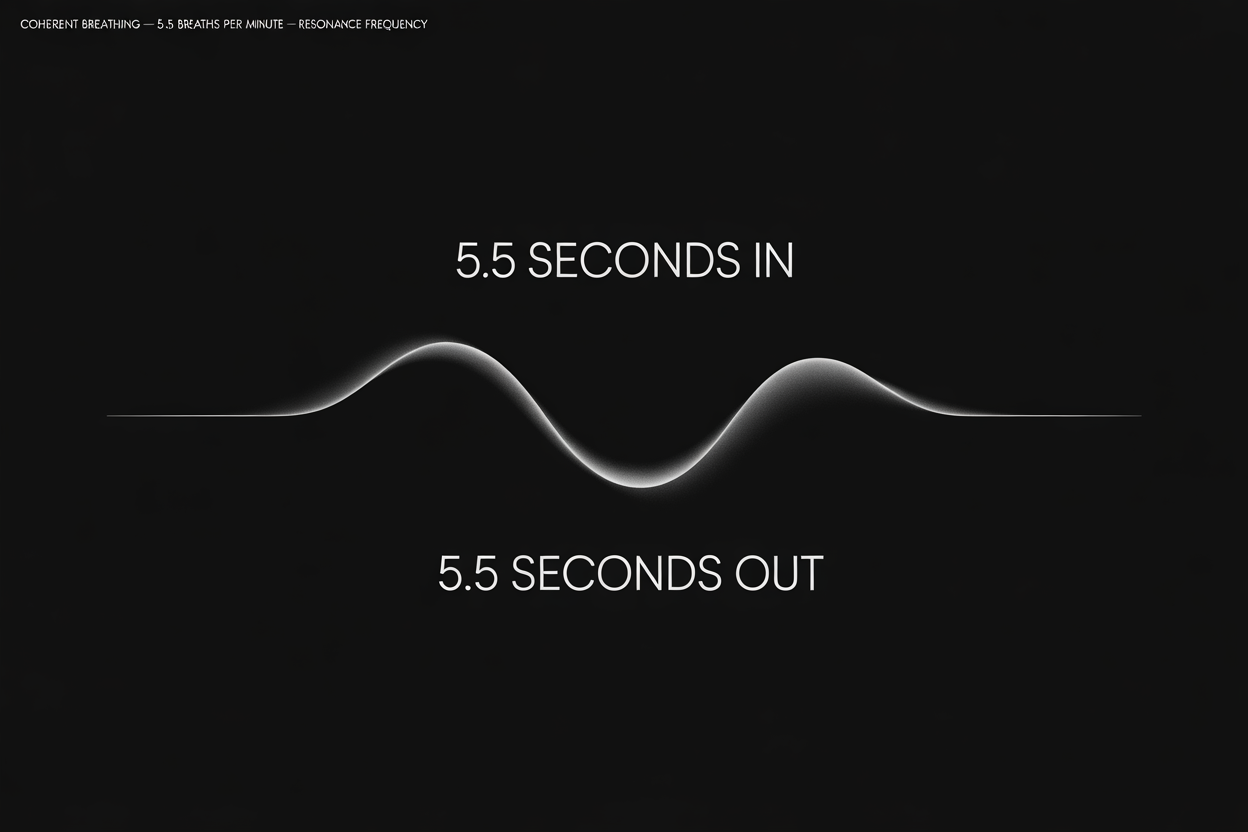
Five breaths per minute is one of the simplest ways to turn breathing from a vague relaxation habit into a measurable practice. The pace is easy to remember: inhale for six seconds, exhale for six seconds, then repeat. That creates five complete breath cycles in one minute.
This is why the phrase shows up so often around HRV breathing, coherent breathing, and resonance breathing. It is slow enough to move the heart rhythm visibly with the breath, but not so slow that most beginners need breath holds or strain.
Practice Coherent Breathing on iPhone
Guided Coherent Breathing sessions with the Heart Rhythm visualization, customizable rounds, and HealthKit logging. Free to start.
What 5 breaths per minute means
A normal resting breathing rate is often much faster than five breaths per minute. Many adults breathe somewhere around twelve to twenty times per minute without thinking about it. At five breaths per minute, each breath cycle lasts twelve seconds:
| Phase | Duration |
|---|---|
| Inhale | 6 seconds |
| Exhale | 6 seconds |
| Full cycle | 12 seconds |
| One minute | 5 cycles |
The important part is not heroic breath depth. It is rhythm. Your inhale should feel quiet and nasal if possible. Your exhale should be smooth, unforced, and about the same length. There is no pause at the top or bottom unless you naturally need a tiny transition.
If six seconds in and six seconds out feels too slow, start with four seconds in and four seconds out. A pace you can repeat comfortably for five minutes is better than a perfect number that makes you tense.
Why this pace is connected to HRV
HRV, or heart rate variability, is the variation in timing between heartbeats. A healthy heart does not beat like a metronome. The interval between beats subtly lengthens and shortens as the nervous system adapts to breathing, posture, stress, sleep, and recovery.
Breathing affects this rhythm through respiratory sinus arrhythmia: heart rate tends to rise slightly on the inhale and fall slightly on the exhale. Cleveland Clinic's HRV overview describes respiratory sinus arrhythmia as a normal breathing-related reflex and notes that breathing control through biofeedback can improve HRV.
That is the practical logic behind HRV breathing. When you slow the breath to roughly five or six breaths per minute, the heart rhythm, blood pressure rhythm, and respiratory rhythm have more room to synchronize. In research on heart rate variability biofeedback, preset breathing protocols often use about six breaths per minute, while personalized protocols find each person's resonance frequency individually.
So is the magic number five or six? For most people, it is a range. Five breaths per minute is a clean, memorable version of coherent breathing. 5.5 breaths per minute is the classic Refresher coherent breathing pace. Six breaths per minute is common in HRV biofeedback studies. They all sit in the same slow-breathing neighborhood.
How to try it for one minute
Use this as a quick test before committing to a longer session:
- Sit upright with both feet on the floor.
- Relax your jaw, tongue, shoulders, and hands.
- Inhale through your nose for six seconds.
- Exhale through your nose for six seconds.
- Repeat for five total cycles.
At the end, check the result honestly. You are looking for steadiness, not drama. If you feel calmer and your breathing feels smoother, keep the pace. If you feel air hungry, shorten the phases to five seconds or four seconds and build up gradually.
Stop if you feel dizzy, faint, short of breath, or uncomfortable. Slow breathing should feel controlled and sustainable. It should not feel like a test of willpower.
A five-minute coherent breathing session
Once the one-minute version feels easy, use five minutes as the default session length. Five minutes at five breaths per minute gives you twenty-five cycles, which is enough time for the rhythm to settle without making the practice feel like a chore.
The pattern is deliberately plain:
| Minute | What to do |
|---|---|
| 1 | Find the pace and soften unnecessary effort |
| 2 | Make the inhale quiet and the exhale smooth |
| 3 | Keep the breath continuous with no hard stops |
| 4 | Let the belly and lower ribs move before the chest |
| 5 | Finish without rushing the final exhale |
You can do this in the morning as a baseline practice, between work sessions as a reset, or before sleep if you prefer a gentle technique without breath holds. For a more detailed resonance-frequency explanation, read the full coherent breathing HRV guide.
5 breaths per minute vs 4-7-8 breathing
People often compare five-breaths-per-minute breathing with Dr. Weil's 4-7-8 breathing because both are slow and both are used for calming down. They are not the same tool.
Dr. Andrew Weil's 4-7-8 method is a ratio pattern: inhale for four counts, hold for seven counts, then exhale for eight counts. His own 4-7-8 instructions emphasize tongue position, a complete mouth exhale, a quiet nasal inhale, a seven-count hold, and an eight-count mouth exhale.
Five-breaths-per-minute breathing is simpler. There are no holds. The inhale and exhale are equal. The goal is not to create a strong sedating effect; the goal is to create a steady breathing rhythm that pairs well with HRV practice.
| Technique | Pattern | Best for |
|---|---|---|
| 5 breaths per minute | 6 in, 6 out | Daily HRV breathing, steady calm, repeatable practice |
| 4-7-8 breathing | 4 in, 7 hold, 8 out | Bedtime, acute downshifting, long-exhale relaxation |
Use 4-7-8 breathing when you want a stronger bedtime or anxiety-downshift pattern. Use five breaths per minute when you want a clean daily rhythm that you can repeat without counting holds.
Common mistakes
- Breathing too deeply. Slow breathing is not the same as maximal breathing. Keep the volume moderate.
- Turning the exhale into a push. A forced exhale creates tension. Let the air leave steadily.
- Chasing a perfect HRV score. Wearables are useful feedback, but the session should still feel calm and repeatable.
- Adding breath holds. Holds turn this into a different technique. For coherent breathing, keep the wave moving.
- Starting too slow. If six seconds feels strained, begin with four or five seconds per phase.
Practice coherent breathing in Refresher
Refresher includes guided Coherent Breathing with a Heart Rhythm visualization built for this exact family of techniques. Start near five breaths per minute, then adjust the pace until it feels smooth. If you want the classic app preset, use the coherent breathing session. If you want a broader comparison of the techniques in the app, start with the breathing techniques overview.
The best version is the one you will actually repeat: five minutes, once a day, without strain.
Coherent Breathing at 5.5 Breaths per Minute: The HRV Sweet Spot
A continuous, equal-phase breath at the body's resonance frequency. The pattern that maximises heart rate variability and synchronises the cardiovascular and respiratory systems.

4-7-8 Breathing for Sleep: Dr. Andrew Weil's Method, Explained
An asymmetric breathing pattern with a long, deliberate exhale. Built to engage the vagus nerve and tip the body into the parasympathetic state that precedes sleep.
Practice on iPhone
Refresher includes guided sessions for every technique on this site, with HealthKit logging, an Apple Watch companion, and a custom preset builder.
Open in App Store